
Quick Summary
- Capacity Baseline: 40-yard bins provide the maximum legal volume for high-density industrial debris, reducing hauling frequency by up to 40% compared to smaller units.
- Regulatory Alignment: These units are essential for meeting the 2026 Alberta Energy Regulator (AER) Directive 058 requirements for waste segregation.
- Regional Focus: Specialized logistics are required for Heartland zones, including Fort Saskatchewan, Nisku, and Strathcona County.
- Cost Efficiency: High-capacity bins minimize “dry run” fees and optimize the carbon footprint of site logistics.
- Site Safety: Larger bins prevent overflow, reducing the risk of ground contamination and tripping hazards on active construction sites.
- Winter Readiness: Specific placement and maintenance protocols are necessary to prevent bin-to-ground freezing during Alberta’s sub-zero months.
The Alberta Industrial Heartland is currently undergoing one of the most significant infrastructure expansions in North American history. As big projects move from the design phase into heavy construction, the sheer volume of waste generated requires a shift in logistical thinking. If you are a project manager or site foreman in Fort Saskatchewan, Nisku, or Sturgeon County, your goal is likely to maintain a clean, compliant site while minimizing the overhead costs of waste hauling. This guide provides a factual, data-driven analysis of why 40-yard roll-off bin rentals have become the operational baseline for these high-capacity projects. We will examine the intersection of provincial regulations, site constraints, and the specialized equipment needed to move hundreds of tons of debris efficiently.
The Scale of the 2026 Industrial Heartland Expansion
The industrial landscape across the Greater Edmonton Area and the Heartland region is defined by massive-scale petrochemical, hydrogen, and carbon capture projects. These sites differ significantly from standard commercial construction. A single industrial module assembly or refinery turnaround can generate more waste in a week than a residential subdivision does in a year.
Local Considerations for Heartland Zones
Logistics in the Alberta Industrial Heartland are governed by a complex set of local geographic and regulatory factors. When planning a 40-yard roll-off bin rental Alberta, site managers must account for:
- Sturgeon County and Strathcona County Road Bans: Seasonal weight restrictions (spring thaw) can significantly impact the ability to haul fully loaded 40-yard bins. In some zones, trucks may be limited to 75% or 90% of their maximum carrying capacity, requiring a more frequent swap schedule to stay compliant with provincial axle weight laws.
- Nisku Industrial Park Footprints: While the Heartland has vast open spaces, assembly yards in Nisku are often densely packed. This requires “precision spotting” for roll-off bins to ensure that heavy hauling equipment can access the bins without disrupting active crane lifts or module movements.
- Fort Saskatchewan Proximity: Distance from major landfills, such as the Clover Bar Landfill or private industrial waste facilities, dictates the ROI of bin sizing. The further the site is from the disposal point, the more critical the 40-yard capacity becomes to justify the transportation time.
View our waste management solutions!
Why 40-Yard Roll-Off Bins Are the New Standard
In previous decades, 20-yard or 30-yard bins were common on Alberta sites. However, the 2026 economic environment favours the 40-yard unit for several logistical reasons.
Volume and Dimensions
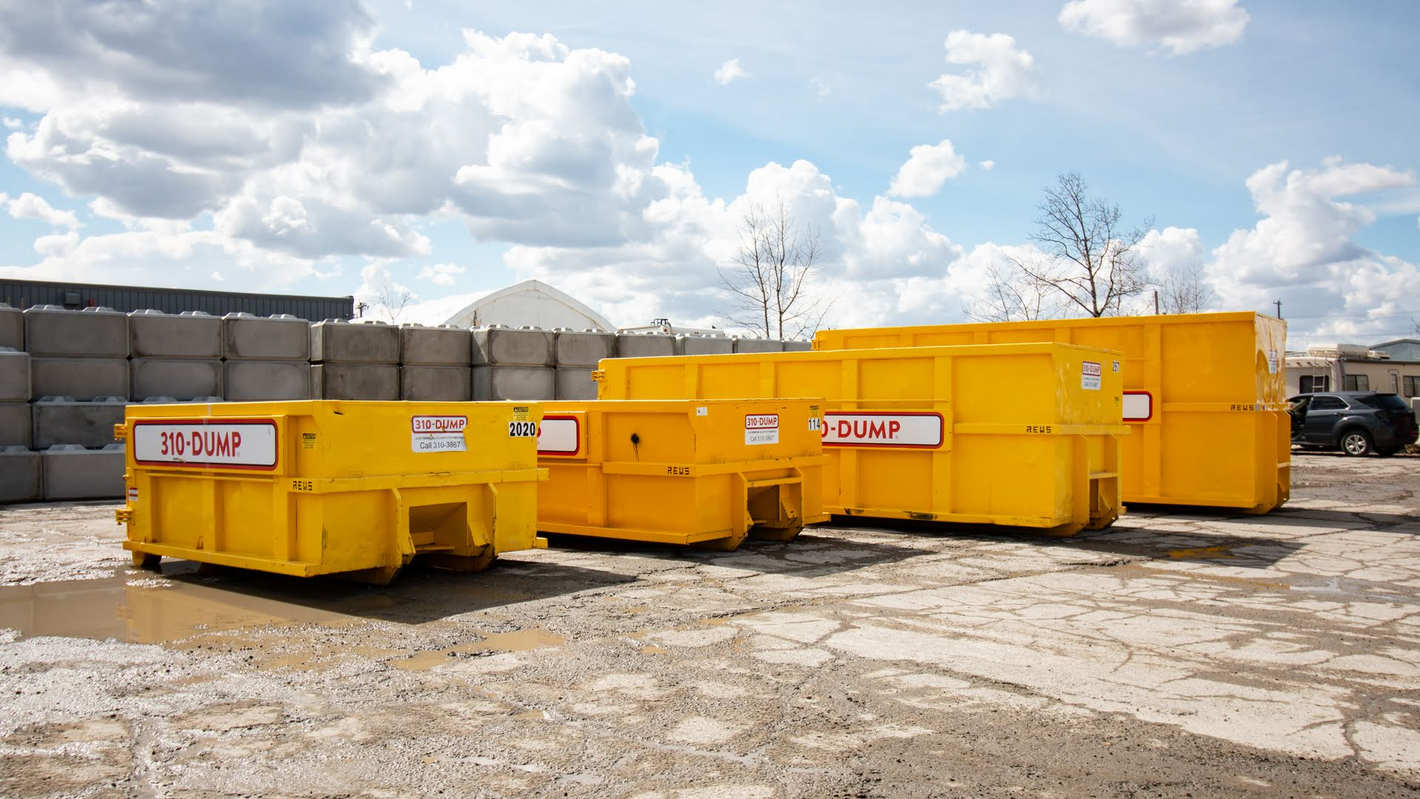
A standard 40-yard roll-off bin typically measures 22 feet in length, 8 feet in width, and 8 feet in height. This volume is equivalent to approximately 15 to 20 pickup truck loads. For industrial sites, this allows for the disposal of:
- Large-scale wooden crating and dunnage.
- Long segments of scrap piping and conduit.
- High-volume insulation and cladding waste.
- Non-hazardous demolition debris from facility retrofits.
The ROI of Tonnage and Pull Frequencies
Waste management costs are primarily driven by two factors: the pull fee (the cost to move the truck) and the tipping fee (the weight-based disposal cost). By maximizing the volume in a single pull, a project can significantly reduce the number of truck movements on-site.
| Bin Size | Max Volume (Cubic Yards) | Ideal Use Case | Pull Frequency (High Volume Site) |
| 12-Yard | 12 | Concrete, Dirt, Heavy Debris | Daily |
| 20-Yard | 20 | Roofing, Small Renovations | Every 3 Days |
| 30-Yard | 30 | General Construction | Every 2 Days |
| 40-Yard | 40 | Industrial Heartland Projects | Weekly / Bi-Weekly |
The 2026 Compliance Layer: AER Directive 058
One of the most critical aspects of Industrial Heartland waste management is compliance with the Alberta Energy Regulator’s (AER) Directive 058. This directive governs the handling, storage, and disposal of oilfield waste.
Generator Knowledge and Documentation
Under the 2026 standards, “Generator Knowledge” is the legal baseline. This means the operator of the site is responsible for accurately identifying and classifying all waste before it leaves the site. 40-yard bins facilitate this by allowing for dedicated, high-volume bins for specific waste streams. For example, a site may have one 40-yard bin strictly for “Directive 058 Recyclable Wood” and another for “Non-Hazardous Industrial Debris.”
Using a digital manifest system linked to the bin’s serial number allows for real-time tracking of waste volumes. This level of Edmonton waste management integration is no longer optional for major contractors; it is a prerequisite for bidding on multi-stage industrial contracts.
The Integrated Waste Flow Model
To optimize high-capacity logistics, industry leaders recommend an “Integrated Waste Flow Model.” This process ensures that bins are never sitting idle and that the site never reaches a “waste-stop” condition where work must cease due to debris accumulation.
The Five-Stage Waste Flow Process
- Volume Forecasting: Based on the project schedule (e.g., the crating-out phase of a module delivery), waste volumes are predicted 14 days in advance.
- Strategic Staging: 40-yard bins are placed at the primary point of generation to minimize manual handling.
- The “Swing-Swap” Execution: A replacement bin is delivered at the same time the full bin is picked up. This ensures the site is never without a disposal point.
- Diversion Auditing: Contents are inspected before hauling to ensure no hazardous materials have been co-mingled, protecting the generator from liability.
- Manifest Closing: Digital disposal receipts are uploaded to the project’s environmental management system within 24 hours of tipping.
Service Constraints and Logistical Realities
While 40-yard bins are the most efficient option, they come with specific service constraints that must be managed.
Weight Limits and Overloading
A 40-yard bin can be easily overloaded if filled with heavy materials like concrete or saturated soil. Roll-off trucks have a maximum lifting capacity (usually around 10–12 tons, depending on the hoist). If a bin is filled with heavy industrial scrap, it may become “un-haulable,” leading to significant delays as the bin must be partially emptied by on-site equipment.
Overhead Clearances
These bins are 8 feet tall. When the truck hoists the bin for pickup, the total height can exceed 20 feet. On industrial sites with overhead pipe racks, power lines, or scaffolding, this creates a major logistical hazard. A “spotter” is always required during the loading and unloading of high-capacity bins in restricted areas.
Winter Placement in Alberta
In the Heartland, winter temperatures frequently drop below -30°C. If a bin sits in one spot for an extended period, the metal rails can freeze to the ground. Furthermore, if snow and ice accumulate at the bottom of the bin before it is filled, it adds unnecessary weight and can cause the waste to freeze into a solid block, making it impossible to tip at the landfill.

Get a Quote for Roll-Off Bin Rentals Today!
Implementation Timeline for New Industrial Sites
For projects entering the construction phase in the Alberta Industrial Heartland, the following timeline is recommended for waste logistics setup.
- T-Minus 30 Days: Conduct a site waste audit. Identify the specific waste streams (metal, wood, general debris) and estimate weekly volumes.
- T-Minus 20 Days: Map out bin locations. Ensure all locations have a minimum of 60 feet of straight-line access for the roll-off truck and no overhead obstructions.
- T-Minus 14 Days: Establish account and manifest protocols. Ensure the hauling partner is integrated into the site’s safety and compliance software.
- T-Minus 7 Days: Deliver the first wave of 40-yard bins. Conduct a site orientation for the drivers to review gate access codes and site-specific PPE requirements.
- Day 1 of Construction: Begin the “Swing-Swap” schedule. Adjust pull frequencies based on real-time data from the first week of operation.
Common Mistakes in Industrial Waste Planning
Avoiding these common errors can save a project thousands of dollars in “Dry Run” fees and regulatory fines.
- Underestimating Footprint Needs: Assuming a 40-yard bin only needs 22 feet of space. In reality, the truck needs an additional 40–50 feet of lead space to back in and drop the bin.
- Co-Mingling Hazardous Waste: Placing paint cans, batteries, or aerosol cans into a 40-yard general debris bin. This can lead to the entire load being rejected at the landfill and potential environmental fines for the generator.
- Ignoring Road Bans: Failing to account for seasonal weight restrictions on Sturgeon County backroads, leading to bins being only half-filled to stay under axle weight limits.
- Poor Bin Placement: Placing bins in low-lying areas of the site where spring runoff can pool. This leads to the bin sinking into the mud, making it difficult for the truck to gain the traction needed to pull the load.
What To Do If Something Goes Wrong
Despite the best planning, logistical issues can occur.
- If a Bin is Overweight: Do not attempt to move it with a site forklift. Use an excavator to remove heavy materials (concrete/steel) from the top half of the bin until the weight is within the hoist’s lifting capacity.
- If a Load is rejected: If the landfill finds prohibited items, the bin will be returned to the site. The site must then provide a crew to manually sort the bin, which is a high-cost labour event. Prevent this with pre-pull inspections.
- If Access is Blocked: If site equipment or deliveries block the bin during a scheduled swap, the hauler will charge a “Dry Run” fee. Ensure the waste area is a designated “No Parking/No Staging” zone.
FAQ: Industrial Waste and 40-Yard Bins
How much weight can a 40-yard roll-off bin hold?
While the volume is 40 cubic yards, the weight capacity is limited by the truck’s hoist and provincial road regulations. Generally, you should not exceed 10 tons (20,000 lbs) of debris to ensure the bin can be safely lifted and transported on Alberta highways.
Can 40-yard bins be used for concrete or dirt?
No. A 40-yard bin filled with concrete would far exceed the weight capacity of any roll-off truck. For heavy materials like dirt, rock, or concrete, a 12-yard “rock box” is the industry standard.
What are the height clearance requirements for a 40-yard bin?
The bin itself is 8 feet tall. However, the truck needs approximately 22–25 feet of vertical clearance when hoisting the bin. Always check for overhead lines or pipe racks before scheduling a drop-off.
Is Directive 058 applicable to all Heartland sites?
Directive 058 specifically applies to “oilfield waste.” However, many petrochemical and hydrogen plants in the Heartland adopt Directive 058 standards as a “best practice” for all industrial waste management to ensure a high level of environmental auditability.
Do I need a permit for a 40-yard bin in Fort Saskatchewan?
If the bin is placed on private industrial property, a municipal permit is generally not required. However, if the bin must be placed on a public roadway or easement, you must obtain a temporary occupancy permit from the City of Fort Saskatchewan or the relevant county.
How do I prevent illegal dumping in my 40-yard bin?
On industrial sites, this is best managed by placing bins within fenced, monitored areas. For high-risk sites, 310-DUMP can provide bins with locking lids to ensure that only authorized project waste is disposed of in the container.
Can I get 24-hour service for a refinery turnaround?
Yes. During “Turnaround” or “Shutdown” events, waste volumes spike significantly. Haulers can provide dedicated trucks and drivers to perform continuous “round-robin” bin swaps to keep the site clear during 24/7 operations.
The expansion of the Alberta Industrial Heartland represents a new era of infrastructure development. Managing the waste from these projects is not merely about “junk removal”—it is a critical logistical component that affects site safety, regulatory compliance, and the bottom line. By standardizing on 40-yard roll-off bins and implementing a rigorous waste flow framework, project managers can ensure their sites remain efficient throughout the 2026 construction cycle.
Ready to optimize your Heartland site logistics? Request a custom quote for high-capacity roll-off services and ensure your project stays on schedule and in compliance.
Explore More Articles
Are Edmonton Property Managers Overpaying for Waste Removal? Municipal vs. Private Front-Load Dumpster Costs Compared
Quick Summary Municipal communal bin collection in Edmonton is billed through a fixed monthly waste utility rate, not usage, so heavy-volume properties often pay for capacity they do not fully control. Private front-load dumpster service ...

Calgary Bin Rental Prices: Complete Cost Guide
Calgary Bin Rental Prices: What Determines the Final Cost? One of the first questions customers ask when planning a cleanup, renovation or construction project is: how much does a Calgary bin rental cost? The ...

Calgary Bin Sizes: 10, 15, 30 and 40-Yard Guide
10-Yard, 15-Yard, 30-Yard and 40-Yard Bin Comparisons Choosing the right Calgary bin rental begins with understanding the available container sizes. A bin that is too small may require an additional pickup or exchange. A bin ...


